
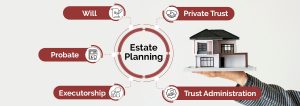
An estate plan allows you to direct the manner in which your property will be distributed after your death
Estate planning is not something that should only be considered by wealthy or retired people. No matter how substantial or modest your assets and property may be, without proper planning one day there can be complications, ambiguities, disputes and high costs for your family.

The basic foundation of your estate plan
At Warmond, we offer one of the simplest means of guaranteeing peace of mind for both you and your loved ones.
This legal document allows you to make decisions on who will administer your estate and distribute your assets on death. In the absence of a Will, the person is said to have died "intestate" and state laws will determine how and to whom the person's assets will be distributed.
Key things to note:
- Your will is the first step of your estate plan.
- A will has no legal authority until after death. So, a will does not help manage a person's assets when they are incapacitated, whether by old age, illness or injury.
- A will does not help avoid probate. It is required to be submitted to the court - it is the foremost step to probate.
- A will is an opportunity to nominate the guardians of your minor child if something happens to you. It is strongly recommended that parents of minor children should document their choice of guardians. If you leave this to destiny, it could result in a family battle and your child could end up with the wrong guardians.
Executorship
Determining who will be in charge of your estate when you are not around is an important decision.
Choosing the right executor is a crucial step in the estate planning process and requires careful consideration. The executor must engage with family members during this period of sorrow while managing conflicts that may arise among beneficiaries during the distribution of the assets. The executor’s actions are subject to scrutiny not only by beneficiaries, but also by regulatory authorities, creditors and the courts.
The pressures of being an executor come along with its potential for personal liability. This can in some cases be overwhelming. You may therefore, want to consider appointing a corporate executor.
Key questions for your consideration:
- Executor’s Age – What if your executor were to predecease you or become incompetent and be unable to fulfill his/ her duties?
- Location – Where does your executor reside? It can be difficult to settle an estate remotely.
- Competency - Does your executor have the required legal, tax, accounting and investment knowledge to make effective decisions? Competency to handle such matters is imperative.
- Time – Will your executor’s personal commitments impact his/her ability to deal with your estate? Fulfilling this role requires substantial investment of time.
- Liability - Is your executor aware of the potential personally liability for errors made in settling an estate? Is he/she willing to accept this liability?
- Disputes – Do you foresee any disputes within among your family members or beneficiaries? Will the executor be independent and non-biased having a professional approach?
- Minors - Does your estate name minor beneficiaries? Is your executor willing and able to continue his/her duties until these beneficiaries reach the age of majority?
- Location of Beneficiaries – Do your beneficiaries reside outside the country?
- Complexity of Assets - Does your estate includes complex assets such as business, partnership or commercial real estate? Does your executor have the expertise to wind up or dispose of these assets in a tax efficient manner?
Probate
Probate is a legal process whereby the validity of a Will is established in a court as the true last testament of the deceased.
As an executor, Warmond helps the family of the deceased in obtaining Probate from the court of competent jurisdiction

Globally, private trusts are widely used as an effective tool for estate and succession planning. High net worth families set up private family trusts for smooth inter- generation transfer of wealth.
In addition to Wills and Executorship, as part of it’s bouquet of estate planning offerings, Warmond helps high net worth families with trust formation and also acts as a corporate trustee for the trusts wherever mandated.
Benefits of setting up a Private Trust:
- No probate requirement
- Protect the interest of current and future generations
- Distribution of assets according to individual wishes or needs, rather than by statutory disposition
- Consolidation of assets
- Wealth preservation
- Administration and management of the trust fund
- Avoid conflict amongst beneficiaries
- Superior structure than a Will
- Address philanthropic needs
- Provide for incapacity of the settlor
- Channel end usage of assets
Who should create a trust?
- Promoters / Business owners who wish to segregate management & control and economic interest
- Indian residents who have beneficiaries residing abroad
- Parents of minor children - managing and preserving wealth for children who are too young or financially incompetent
- Those having special child
- Families desirous of setting up multi-generational trusts
- Those intending to contribute towards philanthropy
- Families looking at rainy day planning
- Those looking at creating life trust for children - protection against failing marriages, other uncertainties in life

Following are the broad scope of work for trusteeship service:
- Managing and administering assets under the trust
- Keeping books and accounts
- Administering investments
- Acting in the best interests of the beneficiaries
- Implementing the directions of the settlor
- Distributing assets to the beneficiaries in the manner provided by the settlor
Benefits of appointing a Corporate Trustee:
- Independent
- Professional approach
- Continuity
- Better control over assets
- Operational efficiency
- Easy accessibility